


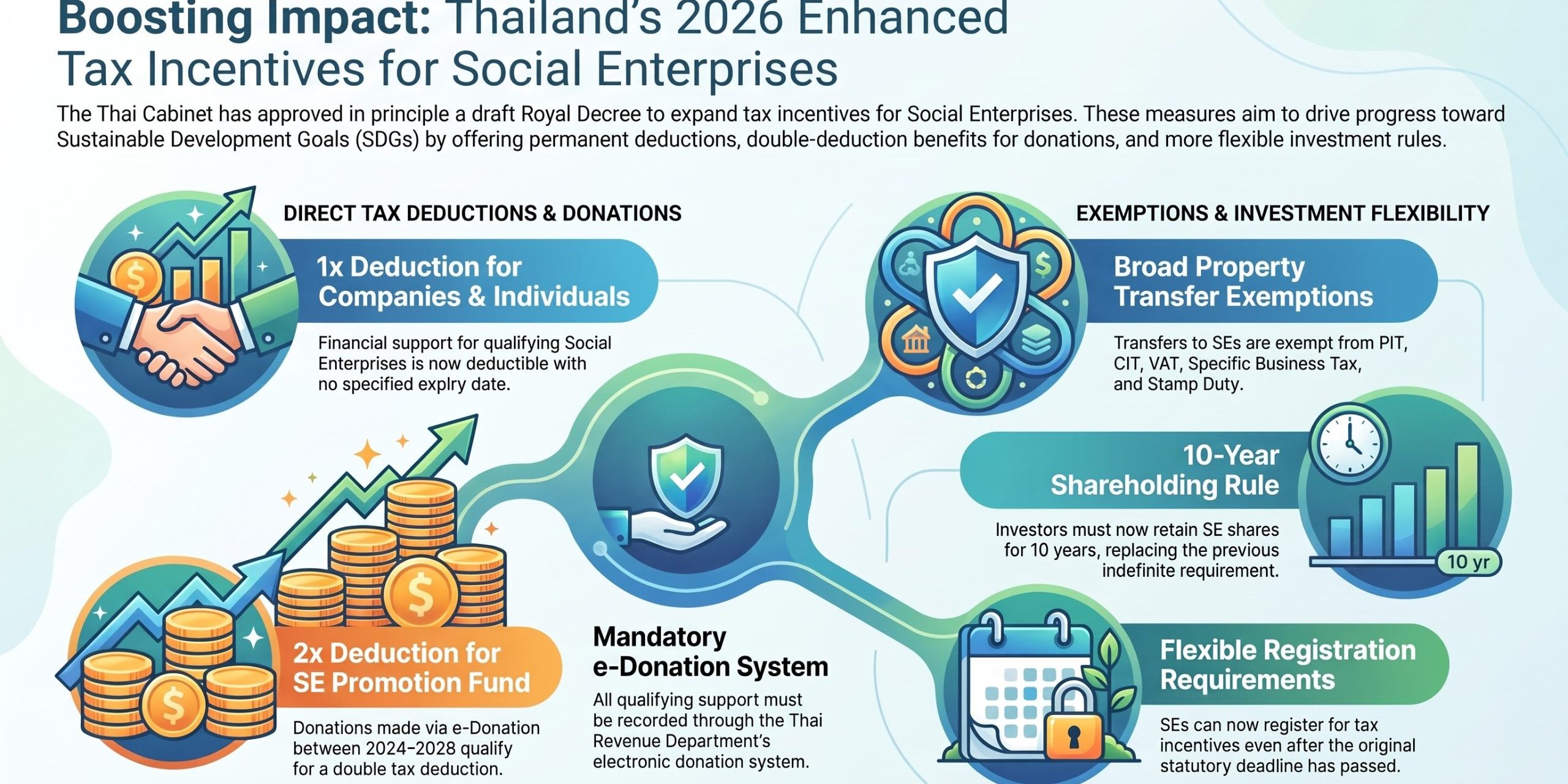
Thailand Social Enterprise Tax Incentives could expand under proposed measures that support Social Enterprises (SEs) and encourage greater participation by companies, individual taxpayers, donors and investors.
On 21 July 2026, the Thai Cabinet approved in principle a draft Royal Decree to amend and improve existing tax incentives for Social Enterprises.
The proposed measures aim to provide broader and more continuous support for Social Enterprises, recognising their role in addressing social challenges and contributing to Thailand’s progress toward the United Nations Sustainable Development Goals (SDGs).
What is a Social Enterprise?
A Social Enterprise is generally a business that conducts commercial activities while pursuing social, community or environmental objectives.
Thailand has introduced tax incentives to encourage individuals, companies and investors to support qualifying Social Enterprises and the Social Enterprise Promotion Fund.
The latest proposal seeks to expand those incentives further.
5 Key Proposed Tax Measures for Social Enterprises in Thailand
1. Companies supporting Social Enterprises may claim a one-times expense deduction without an expiry date
Under the previous measure, a company or juristic partnership providing money or property to support a Social Enterprise could claim a tax expense deduction equal to one times the qualifying amount, with the incentive previously scheduled to expire on 31 December 2023.
Under the proposed amendment, the government would extend this incentive without a specified expiry date.
This may provide greater certainty for businesses wishing to support Social Enterprises as part of their long-term social, CSR or ESG initiatives, subject to applicable tax requirements.
2. Individual taxpayers may claim a one-times tax deduction
The proposed measures introduce an additional incentive for individual taxpayers who provide financial support to qualifying Social Enterprises.
Eligible financial contributions would be deductible at one times the qualifying amount, with no specified expiry date.
The actual availability and amount of any tax deduction remain subject to the conditions and limitations prescribed by Thai tax law.
3. Double tax deduction for donations to the Social Enterprise Promotion Fund
One of the most significant proposed incentives concerns donations of money or property to the Social Enterprise Promotion Fund.
The deduction would increase from one times to two times the qualifying donation.
The enhanced incentive would apply to qualifying donations made between:
1 January 2024 and 31 December 2028.
Taxpayers must nevertheless comply with all applicable statutory requirements and conditions.
e-Donation Requirement
The proposed measures require taxpayers to make qualifying support and donations through the Thai Revenue Department’s electronic donation system (e-Donation).
Companies and individuals intending to claim these tax benefits should therefore confirm that the relevant recipient, Social Enterprise or fund qualifies under the Revenue Department’s requirements and ensure that the transaction appears correctly in the e-Donation system.
4. Extension of tax exemptions for transfers and donations of property
The draft measure also proposes extending tax exemptions for individuals, companies and juristic partnerships that transfer property to qualifying Social Enterprises or donate property to the Social Enterprise Promotion Fund through the e-Donation system.
The proposed exemptions cover several types of Thai taxation, including:
- Personal Income Tax
- Corporate Income Tax
- Value Added Tax (VAT)
- Specific Business Tax
- Stamp Duty
These exemptions previously applied until 31 December 2023. The proposal would extend them without a specified expiry date.
5. More flexible registration for Social Enterprise tax incentives
The proposed amendment also seeks to relax the registration requirements applicable to Social Enterprises wishing to obtain tax incentives.
A Social Enterprise that misses the original statutory notification deadline may still register later.
However, if a Social Enterprise registers after the prescribed deadline, its tax incentives and those available to its supporters would generally commence from the accounting period or tax year following the period or year in which it submits the notification.
Investors may only need to hold their investment for 10 years
The Revenue Department has also indicated that, once the new Royal Decree comes into force, it expects to amend Revenue Department Director-General Notification No. 38.
The proposed change relates to tax deductions for investments in shares or partnership interests made for the establishment or capital increase of a Social Enterprise.
Under the proposed rule, an investor would need to retain the relevant shares or partnership interest for at least 10 years from the investment date.
This would replace the existing rule requiring investors to retain the investment indefinitely.
According to the Revenue Department announcement, the revised rule should also cover earlier investments that predate the new Royal Decree.
Who should monitor these changes?
The proposed measures are particularly relevant to several groups.
Social Enterprises
Social Enterprises should review their registration status, tax-incentive notification requirements and ability to participate in the Revenue Department’s e-Donation system.
Thai Companies and Juristic Partnerships
Businesses undertaking CSR, ESG or other social-support programmes should assess whether qualifying contributions could benefit from available tax deductions.
Individual Taxpayers
Individuals financially supporting qualifying Social Enterprises may become entitled to additional personal income tax deductions, subject to statutory conditions.
Investors
The proposed 10-year holding requirement may provide greater flexibility for investors considering investments in Social Enterprises.
Important: Cabinet Approval in Principle Does Not Yet Make the Measures Fully Effective Law
The Revenue Department’s announcement dated 21 July 2026 states that the Cabinet approved in principle a draft Royal Decree.
Accordingly, taxpayers should not assume that they can immediately apply every proposed measure to a tax return or transaction without first checking the final legislation and its effective date.
Before claiming a tax incentive, taxpayers should verify, among other matters:
- whether the new Royal Decree has entered into force;
- the applicable effective date;
- whether both the contributor and recipient satisfy the prescribed conditions;
- whether the transaction appears correctly in the e-Donation system;
- whether any statutory deduction limits or other tax conditions apply.
Conclusion
Overall, the proposed Thailand Social Enterprise Tax Incentives could provide broader tax benefits for companies, individuals, donors and investors supporting qualifying Social Enterprises. Thailand’s proposed Social Enterprise tax measures represent a significant expansion of tax incentives available to businesses, individuals, donors and investors supporting socially responsible enterprises.
Key proposals include continuing one-times deductions for corporate supporters, introducing deductions for individual supporters, providing double deductions for qualifying donations to the Social Enterprise Promotion Fund, extending certain tax exemptions and relaxing investment and registration requirements.
Businesses and taxpayers intending to rely on these incentives should continue to monitor the final Royal Decree, Revenue Department notifications and related implementation rules before claiming the relevant tax benefits.
Bookkeeping Co., Ltd.
We provide accounting, tax compliance, financial reporting, audit coordination and tax advisory services for Thai and foreign-owned businesses operating in Thailand.
If your company requires assistance in assessing the Thai tax implications of donations, Social Enterprise support, CSR or ESG programmes, or other corporate tax matters, our team can review the particular facts and applicable tax requirements.
Source: The Revenue Department of Thailand, Press Release No. 17/2569 dated 21 July 2026.
Disclaimer: We provide this article for general informational purposes only. It does not constitute legal, tax or accounting advice for any particular transaction. Before claiming any tax incentive, taxpayers should review the applicable legislation, notifications and Revenue Department requirements.